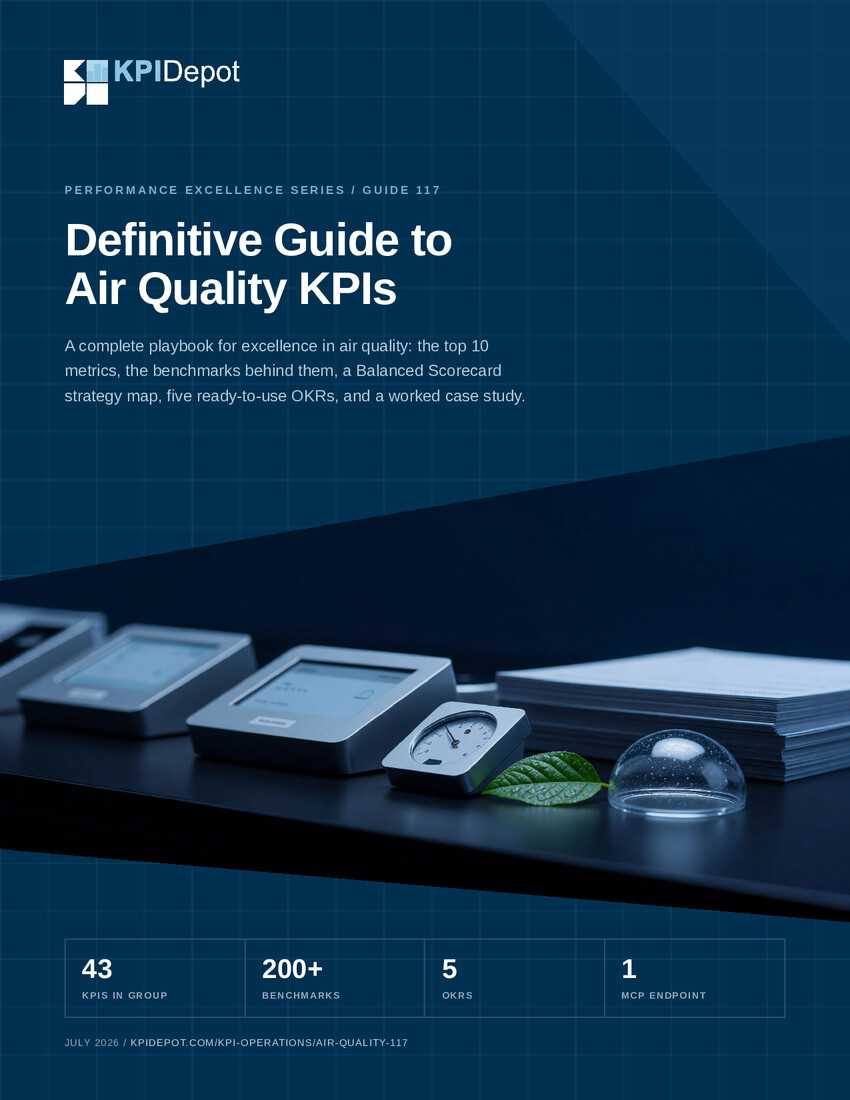
12 Most Important Air Quality KPIs
The top KPIs for Air Quality are pivotal in Operations Management as they provide quantifiable measures to assess environmental performance and compliance with regulations. By tracking specific indicators such as particulate matter concentration, nitrogen oxide levels, or carbon monoxide emissions, organizations can identify trends and pinpoint areas requiring improvement.
These metrics are also essential for benchmarking against industry standards and establishing accountability for reducing pollutants.
This article showcases the Most Critical 12 KPIs for Air Quality and Associated Benchmarks.
1. Average Emissions Level
Average Emissions Level serves as a pivotal KPI for organizations aiming to enhance operational efficiency and align with sustainability goals.
It directly influences financial health by impacting regulatory compliance costs and potential penalties. Additionally, this metric aids in forecasting accuracy for future emissions-related expenditures, thereby supporting strategic alignment with environmental initiatives.
Companies that effectively track this KPI can improve their ROI metric by optimizing resource allocation and minimizing waste. Learn more about the Average Emissions Level KPI.
View Common Pitfalls
View Improvement Levers
We have 1 benchmark for this KPI available in our database.
2. Air Quality Index (AQI) Performance
Air Quality Index (AQI) performance is crucial for assessing environmental health and regulatory compliance.
It influences public health outcomes, operational efficiency, and corporate sustainability initiatives. High AQI values can indicate pollution levels that may lead to health advisories, while low values reflect cleaner air and better living conditions.
Organizations that leverage AQI data can enhance their strategic alignment with environmental goals, driving positive business outcomes. Learn more about the Air Quality Index (AQI) Performance KPI.
View Common Pitfalls
View Improvement Levers
We have 1 benchmark for this KPI available in our database.
3. Carbon Footprint
Carbon Footprint is a critical KPI that measures the total greenhouse gas emissions produced directly and indirectly by an organization.
It influences business outcomes such as regulatory compliance, brand reputation, and operational efficiency. By tracking this metric, companies can make data-driven decisions to reduce their environmental impact while improving financial health.
Effective management reporting on carbon emissions can also enhance stakeholder trust and align with sustainability goals. Learn more about the Carbon Footprint KPI.
View Common Pitfalls
View Improvement Levers
We have 5 benchmarks for this KPI available in our database.
Related KPI Categories
4. Greenhouse Gas Emissions Intensity
Greenhouse Gas Emissions Intensity (GHG EI) serves as a critical metric for organizations aiming to enhance operational efficiency and align with sustainability goals.
It measures the amount of greenhouse gas emissions produced per unit of output, influencing both regulatory compliance and corporate reputation. A lower GHG EI indicates effective resource utilization and can improve financial health by reducing costs associated with emissions.
Companies that actively manage this KPI often see enhanced stakeholder trust and better access to capital. Learn more about the Greenhouse Gas Emissions Intensity KPI.
View Common Pitfalls
View Improvement Levers
We have 5 benchmarks for this KPI available in our database.
Related KPI Categories
5. Nitrogen Oxides (NOx) Emissions
Nitrogen Oxides (NOx) emissions are critical indicators of environmental impact and regulatory compliance.
High NOx levels can lead to significant penalties and damage to corporate reputation, affecting overall financial health. Companies that actively manage NOx emissions often see improved operational efficiency and enhanced stakeholder trust.
By leveraging data-driven decision-making, organizations can track results and align their strategies with sustainability goals. Learn more about the Nitrogen Oxides (NOx) Emissions KPI.
View Common Pitfalls
View Improvement Levers
We have 7 benchmarks for this KPI available in our database.
6. Sulfur Dioxide (SO2) Emissions
Sulfur Dioxide (SO2) emissions are a critical performance indicator for organizations aiming to enhance operational efficiency and comply with environmental regulations.
Monitoring SO2 levels influences business outcomes such as regulatory compliance, public health, and corporate sustainability initiatives. High emissions can lead to increased scrutiny from regulators and potential fines, while low emissions often correlate with improved community relations and brand reputation.
Companies that prioritize SO2 reduction can also realize cost savings through energy efficiency and waste reduction strategies. Learn more about the Sulfur Dioxide (SO2) Emissions KPI.
View Common Pitfalls
View Improvement Levers
We have 3 benchmarks for this KPI available in our database.
7. Volatile Organic Compounds (VOCs) Released
Volatile Organic Compounds (VOCs) released is a critical KPI for organizations aiming to enhance operational efficiency and regulatory compliance.
High VOC emissions can indicate inefficiencies in production processes, leading to increased costs and potential fines. By monitoring this metric, businesses can improve their environmental footprint and align with sustainability goals.
Effective management of VOCs can also enhance brand reputation and customer trust. Learn more about the Volatile Organic Compounds (VOCs) Released KPI.
View Common Pitfalls
View Improvement Levers
We have 1 benchmark for this KPI available in our database.
8. Particulate Matter (PM2.5) Concentration
Particulate Matter (PM2.5) concentration is a critical KPI for assessing air quality and public health.
Elevated levels can lead to increased healthcare costs and reduced workforce productivity, impacting overall financial health. Organizations that monitor PM2.5 effectively can enhance operational efficiency and align with regulatory standards.
By leveraging data-driven decision-making, businesses can track results and improve community relations. Learn more about the Particulate Matter (PM2.5) Concentration KPI.
View Common Pitfalls
View Improvement Levers
We have 1 benchmark for this KPI available in our database.
9. Particulate Matter (PM10) Concentration
Particulate Matter (PM10) concentration is a critical environmental KPI that directly impacts public health and operational efficiency.
High PM10 levels can lead to increased respiratory issues, affecting workforce productivity and healthcare costs. Monitoring this KPI enables organizations to align with regulatory standards and improve community relations.
Companies that proactively manage PM10 levels can enhance their brand reputation and achieve better strategic alignment with sustainability goals. Learn more about the Particulate Matter (PM10) Concentration KPI.
View Common Pitfalls
View Improvement Levers
We have 9 benchmarks for this KPI available in our database.
10. Ozone (O3) Level Monitoring
Ozone (O3) level monitoring is critical for assessing air quality and public health.
Elevated O3 levels can lead to respiratory issues, impacting workforce productivity and healthcare costs. By tracking O3 levels, organizations can align with environmental regulations and improve community relations.
Effective monitoring also supports strategic initiatives aimed at enhancing operational efficiency and reducing liabilities. Learn more about the Ozone (O3) Level Monitoring KPI.
View Common Pitfalls
View Improvement Levers
We have 4 benchmarks for this KPI available in our database.
11. Carbon Monoxide (CO) Emissions
Carbon Monoxide (CO) emissions are a critical performance indicator for assessing environmental impact and regulatory compliance.
High levels can indicate operational inefficiencies and pose risks to public health. Monitoring CO emissions helps organizations align with sustainability goals and improve financial health by avoiding penalties.
Effective management of this KPI can enhance operational efficiency, leading to better business outcomes. Learn more about the Carbon Monoxide (CO) Emissions KPI.
View Common Pitfalls
View Improvement Levers
We have 11 benchmarks for this KPI available in our database.
12. Lead (Pb) Emissions
Lead (Pb) emissions are a critical KPI for organizations aiming to enhance operational efficiency and ensure regulatory compliance.
High levels of lead emissions can lead to significant financial liabilities and damage to brand reputation. Monitoring this KPI allows companies to track results and make data-driven decisions that align with sustainability goals.
Reducing lead emissions not only improves environmental impact but also strengthens financial health by minimizing potential fines and legal costs. Learn more about the Lead (Pb) Emissions KPI.
View Common Pitfalls
View Improvement Levers
We have 6 benchmarks for this KPI available in our database.
These 12 Air Quality KPIs were selected from the KPI Depot database to provide a balanced view of emissions and ambient air quality. They combine lagging indicators like Carbon Footprint and Greenhouse Gas Emissions Intensity with leading pollutant-specific metrics such as NOx, SO2, and VOCs emissions. This subset captures both operational output impact and public health-related air quality measures, ensuring comprehensive monitoring across environmental and regulatory priorities.
Track Average Emissions Level alongside AQI Performance to detect discrepancies between pollutant concentrations and overall air quality impact. Rising Greenhouse Gas Emissions Intensity with stable Carbon Footprint signals efficiency losses in production processes. Monitor NOx Emissions in conjunction with Ozone Level Monitoring—divergence between these KPIs may indicate secondary pollutant formation or ineffective emission controls.
Prioritize implementing AQI Performance and Carbon Footprint first, as these are widely reported and provide immediate insight into overall air quality and climate impact. Follow with Nitrogen Oxides (NOx) Emissions to pinpoint specific pollutant sources. This sequencing leverages data availability and diagnostic value to accelerate actionable insights. The full Air Quality KPI set, with detailed formulas and benchmarks, is available in the KPI Depot database.
Related Best Practices
These best practice documents below are available for individual purchase from Flevy , the largest knowledge base of business frameworks, templates, and financial models available online.



