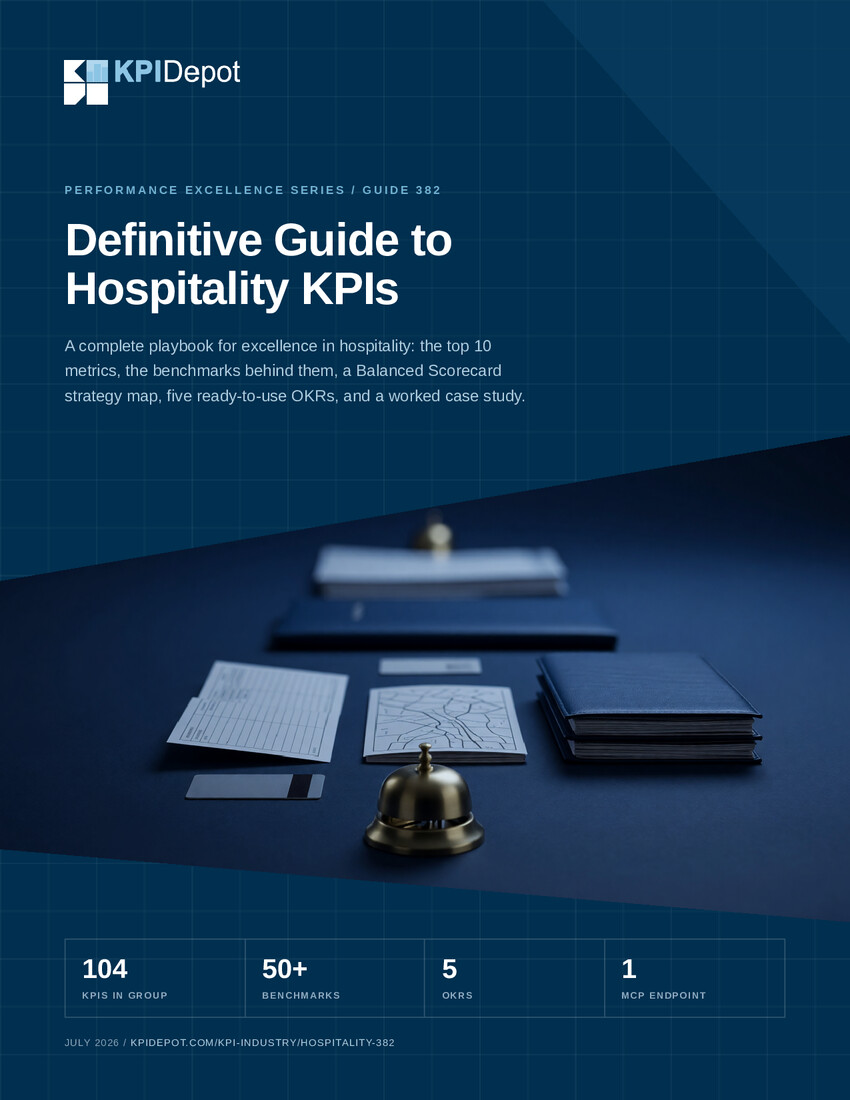
12 Most Important Hospitality KPIs
The top KPIs in the Hospitality industry are crucial for tracking guest satisfaction, operational efficiency, and financial performance. Guest-related metrics, such as satisfaction scores, repeat visit rates, and net promoter scores, provide insights into the quality of service and guest experience.
Operational KPIs, including occupancy rates, average length of stay, and room turnover time, are essential for assessing the efficiency and effectiveness of hospitality operations.
This article showcases the Most Critical 12 KPIs for Hospitality and Associated Benchmarks.
1. Employee Turnover Rate
Employee Turnover Rate serves as a crucial performance indicator for organizations, reflecting the stability and satisfaction of the workforce.
High turnover can lead to increased recruitment costs, disruption in team dynamics, and loss of institutional knowledge. Conversely, low turnover often correlates with enhanced operational efficiency and employee engagement, driving better business outcomes.
By monitoring this KPI, executives can make data-driven decisions to improve retention strategies, ultimately impacting financial health and productivity. Learn more about the Employee Turnover Rate KPI.
View Common Pitfalls
View Improvement Levers
We have 10 benchmarks for this KPI available in our database.
Related KPI Categories
2. Social Media Engagement Rate
Social Media Engagement Rate is a crucial performance indicator that reflects how effectively a brand connects with its audience.
High engagement levels often correlate with increased brand loyalty and customer retention, driving sales and enhancing market presence. This metric serves as a leading indicator of overall marketing effectiveness, enabling companies to track results and make data-driven decisions.
By analyzing engagement, businesses can identify trends and optimize content strategies, ultimately improving financial health. Learn more about the Social Media Engagement Rate KPI.
View Common Pitfalls
View Improvement Levers
We have 29 benchmarks for this KPI available in our database.
Related KPI Categories
3. Website Traffic
Website Traffic serves as a critical performance indicator that reflects user engagement and the effectiveness of marketing strategies.
It directly influences revenue generation, brand visibility, and customer acquisition efforts. High traffic levels can indicate successful campaigns, while low figures may signal the need for strategic realignment.
Tracking this KPI enables organizations to measure the impact of digital initiatives and optimize resource allocation. Learn more about the Website Traffic KPI.
View Common Pitfalls
View Improvement Levers
We have 3 benchmarks for this KPI available in our database.
Related KPI Categories
4. Complaint Resolution Rate
Complaint Resolution Rate is a critical KPI that reflects an organization's ability to address customer grievances effectively.
High resolution rates can lead to improved customer satisfaction, loyalty, and retention, ultimately driving revenue growth. Conversely, low rates may indicate operational inefficiencies, leading to increased churn and negative brand perception.
By focusing on this metric, businesses can enhance their service quality and align operational strategies with customer expectations. Learn more about the Complaint Resolution Rate KPI.
View Common Pitfalls
View Improvement Levers
We have 3 benchmarks for this KPI available in our database.
Related KPI Categories
5. Customer Acquisition Cost (CAC)
Customer Acquisition Cost (CAC) is a vital metric that gauges the cost of acquiring new customers, directly impacting financial health and profitability.
A high CAC can indicate inefficiencies in marketing and sales strategies, leading to reduced ROI. Conversely, a low CAC suggests effective customer engagement and cost control.
This KPI influences critical business outcomes, including revenue growth and customer lifetime value. Learn more about the Customer Acquisition Cost (CAC) KPI.
View Common Pitfalls
View Improvement Levers
We have 13 benchmarks for this KPI available in our database.
Related KPI Categories
6. Customer Lifetime Value (CLV)
Customer Lifetime Value (CLV) is a pivotal metric that quantifies the total revenue a business can expect from a single customer account throughout the relationship.
It directly influences strategic alignment, customer acquisition costs, and overall financial health. By understanding CLV, executives can make data-driven decisions to optimize marketing spend and enhance customer retention strategies.
A higher CLV indicates effective customer engagement and loyalty, while a lower CLV may signal operational inefficiencies or misaligned offerings. Learn more about the Customer Lifetime Value (CLV) KPI.
View Common Pitfalls
View Improvement Levers
We have 2 benchmarks for this KPI available in our database.
Related KPI Categories
7. Training Investment Per Employee
Training Investment per Employee serves as a critical performance indicator for organizations aiming to enhance operational efficiency and employee engagement.
By measuring the financial commitment to workforce development, companies can directly influence business outcomes such as productivity, retention rates, and innovation. A well-structured KPI framework helps align training initiatives with strategic goals, ensuring that investments yield a strong ROI metric.
Organizations that prioritize training often see improved employee morale and a more agile workforce. Learn more about the Training Investment Per Employee KPI.
View Common Pitfalls
View Improvement Levers
We have 12 benchmarks for this KPI available in our database.
Related KPI Categories
8. Emergency Response Time
Emergency Response Time is a critical performance indicator that reflects how swiftly an organization reacts to emergencies, directly influencing operational efficiency and customer satisfaction.
A shorter response time can enhance service delivery, leading to improved customer loyalty and retention. Conversely, delays can escalate risks, resulting in financial losses and reputational damage.
Organizations that prioritize this KPI often see better resource allocation and strategic alignment across departments. Learn more about the Emergency Response Time KPI.
View Common Pitfalls
View Improvement Levers
We have 17 benchmarks for this KPI available in our database.
Related KPI Categories
9. Employee Training Completion Rate
Employee Training Completion Rate is a critical KPI that reflects an organization's commitment to workforce development and operational efficiency.
High completion rates correlate with improved employee performance, reduced turnover, and enhanced financial health. Organizations that prioritize training often see a direct impact on productivity and innovation, driving better business outcomes.
By tracking this metric, leaders can make data-driven decisions that align with strategic goals, ensuring resources are allocated effectively. Learn more about the Employee Training Completion Rate KPI.
View Common Pitfalls
View Improvement Levers
We have 7 benchmarks for this KPI available in our database.
Related KPI Categories
10. Referral Program Effectiveness
Referral Program Effectiveness is crucial for driving customer acquisition and enhancing brand loyalty.
A well-structured referral program can significantly boost customer lifetime value and reduce customer acquisition costs. By leveraging existing customers to attract new ones, organizations can achieve sustainable growth.
This KPI serves as a leading indicator of marketing effectiveness and operational efficiency. Learn more about the Referral Program Effectiveness KPI.
View Common Pitfalls
View Improvement Levers
We have 5 benchmarks for this KPI available in our database.
Related KPI Categories
11. Cultural Event Participation Rate
Cultural Event Participation Rate serves as a vital metric for assessing employee engagement and organizational culture.
High participation rates often correlate with improved morale, retention, and productivity, directly influencing overall business performance. Conversely, low rates may indicate disengagement or a lack of alignment with company values.
Organizations leveraging this KPI can make data-driven decisions to enhance workplace culture, ultimately driving better business outcomes. Learn more about the Cultural Event Participation Rate KPI.
View Common Pitfalls
View Improvement Levers
We have 1 benchmark for this KPI available in our database.
Related KPI Categories
12. Environmental Sustainability Index
The Environmental Sustainability Index (ESI) is crucial for assessing a company's commitment to sustainable practices and its impact on financial health.
It influences business outcomes such as operational efficiency, regulatory compliance, and brand reputation. A high ESI indicates effective resource management and reduced environmental risk, while a low score may signal potential liabilities and missed opportunities for innovation.
Companies leveraging the ESI can enhance stakeholder trust and drive long-term profitability. Learn more about the Environmental Sustainability Index KPI.
View Common Pitfalls
View Improvement Levers
We have 5 benchmarks for this KPI available in our database.
Related KPI Categories
These 12 KPIs were selected from the Hospitality KPI database to provide a balanced view across operational efficiency, guest experience, and financial performance. They combine leading indicators like Employee Training Completion Rate and Social Media Engagement Rate with lagging metrics such as Occupancy Rate and Customer Lifetime Value. This subset captures both internal workforce dynamics and external customer behavior, ensuring comprehensive coverage of hospitality operations.
Track Occupancy Rate alongside Customer Acquisition Cost (CAC) to evaluate marketing efficiency relative to revenue generation. A rising Occupancy Rate with flat or increasing CAC signals diminishing marketing returns or pricing pressure. Monitor Complaint Resolution Rate in tandem with Employee Turnover Rate—high turnover paired with low resolution rates indicates service quality risks. Comparing Referral Program Effectiveness against Social Media Engagement Rate reveals whether guest advocacy aligns with broader brand interaction, highlighting gaps in loyalty activation.
Prioritize implementing Occupancy Rate, CAC, and Complaint Resolution Rate first. These KPIs rely on readily available data and provide immediate diagnostic value across revenue, cost, and service quality dimensions. Follow with Employee Turnover Rate and Social Media Engagement Rate to deepen workforce and brand health insights. The full Hospitality KPI set, with detailed formulas and benchmarks, is accessible in the KPI Depot database for ongoing performance management refinement.
Related Best Practices
These best practice documents below are available for individual purchase from Flevy , the largest knowledge base of business frameworks, templates, and financial models available online.



