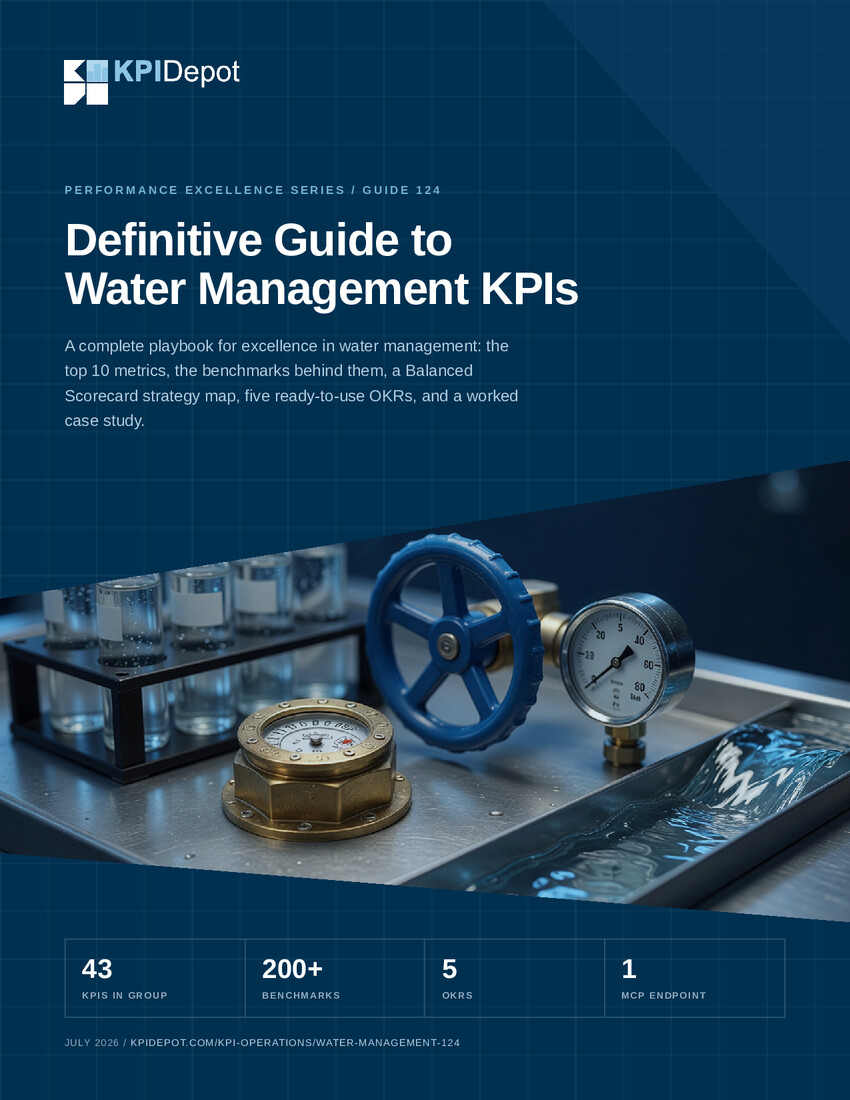
12 Most Important Water Management KPIs
The top KPIs are critical in water management as they provide measurable values that help organizations track and assess the efficiency and effectiveness of their water-related operations. These indicators enable managers to monitor water usage, identify areas for improvement, and implement strategies to conserve water and reduce costs.
By setting specific and relevant KPIs, companies can ensure compliance with environmental regulations and standards, which is crucial for sustainable operations and corporate responsibility.
This article showcases the Most Critical 12 KPIs for Water Management and Associated Benchmarks.
1. Total Water Usage
Total Water Usage is a critical KPI that reflects an organization's operational efficiency and sustainability efforts.
By monitoring this metric, companies can identify areas for cost control and resource optimization, ultimately influencing financial health and environmental impact. Effective management of water usage can lead to significant cost savings, improved ROI, and enhanced corporate reputation.
Organizations that prioritize this KPI can align their strategies with sustainability goals while ensuring compliance with regulations. Learn more about the Total Water Usage KPI.
View Common Pitfalls
View Improvement Levers
We have 18 benchmarks for this KPI available in our database.
2. Fresh Water Withdrawal
Fresh Water Withdrawal is a critical performance indicator that measures the volume of freshwater extracted for various uses, impacting sustainability and operational efficiency.
This KPI influences business outcomes such as regulatory compliance, cost control metrics, and resource allocation. Companies that effectively track this metric can improve their forecasting accuracy and strategic alignment with environmental goals.
By embedding this KPI within a robust KPI framework, organizations can enhance their data-driven decision-making processes. Learn more about the Fresh Water Withdrawal KPI.
View Common Pitfalls
View Improvement Levers
We have 1 benchmark for this KPI available in our database.
3. Wastewater Quality
Wastewater Quality is a critical KPI that reflects the effectiveness of treatment processes and the environmental impact of operations.
It influences regulatory compliance, operational efficiency, and public health outcomes. Monitoring this metric allows organizations to make data-driven decisions that align with sustainability goals.
High-quality wastewater management can enhance a company's reputation and reduce costs associated with penalties or remediation. Learn more about the Wastewater Quality KPI.
View Common Pitfalls
View Improvement Levers
We have 5 benchmarks for this KPI available in our database.
4. Water Quality Monitoring Frequency
Water Quality Monitoring Frequency is crucial for ensuring safe drinking water and environmental sustainability.
It directly influences public health outcomes and regulatory compliance. Frequent monitoring allows organizations to track results effectively, enabling data-driven decision-making.
A robust KPI framework here can enhance operational efficiency and improve financial health by minimizing costly violations. Learn more about the Water Quality Monitoring Frequency KPI.
View Common Pitfalls
View Improvement Levers
We have 5 benchmarks for this KPI available in our database.
Related KPI Categories
5. Water Compliance Incidents
Water Compliance Incidents serve as a critical performance indicator for organizations managing water resources.
This KPI directly influences operational efficiency, regulatory compliance, and financial health. High incident rates can signal underlying issues that may affect overall business outcomes, including increased costs and reputational damage.
Effective tracking and management of these incidents can lead to improved strategic alignment and better resource allocation. Learn more about the Water Compliance Incidents KPI.
View Common Pitfalls
View Improvement Levers
We have 3 benchmarks for this KPI available in our database.
6. Non-Revenue Water (NRW)
Non-Revenue Water (NRW) is a critical KPI for water utilities, reflecting the volume of water produced but not billed to customers.
High NRW levels can indicate inefficiencies in operations, impacting financial health and service delivery. Reducing NRW can lead to significant cost savings and improved operational efficiency, ultimately enhancing customer satisfaction.
Effective management reporting and strategic alignment around NRW can drive better business outcomes. Learn more about the Non-Revenue Water (NRW) KPI.
View Common Pitfalls
View Improvement Levers
We have 7 benchmarks for this KPI available in our database.
Related KPI Categories
7. Water Treatment Costs
Water Treatment Costs serve as a critical performance indicator for organizations managing water resources.
This KPI directly influences financial health, operational efficiency, and cost control metrics. By tracking these costs, companies can identify inefficiencies and optimize resource allocation.
A focus on water treatment expenses can lead to improved sustainability initiatives and compliance with regulatory standards. Learn more about the Water Treatment Costs KPI.
View Common Pitfalls
View Improvement Levers
We have 7 benchmarks for this KPI available in our database.
8. Water Supply Resilience
Water Supply Resilience is crucial for ensuring consistent access to clean water, which directly impacts public health and economic stability.
A resilient water supply system minimizes disruptions, thereby enhancing operational efficiency and safeguarding financial health. By focusing on this KPI, organizations can improve strategic alignment with sustainability goals and community needs.
Effective management reporting on water resilience can lead to better forecasting accuracy and informed decision-making. Learn more about the Water Supply Resilience KPI.
View Common Pitfalls
View Improvement Levers
We have 5 benchmarks for this KPI available in our database.
9. Water Storage Capacity
Water Storage Capacity is a critical performance indicator that directly impacts operational efficiency and financial health.
It influences business outcomes such as resource allocation, cost control, and risk management. A well-optimized water storage system ensures that organizations can meet demand fluctuations without incurring unnecessary costs.
By tracking results, companies can improve forecasting accuracy and strategic alignment with market needs. Learn more about the Water Storage Capacity KPI.
View Common Pitfalls
View Improvement Levers
We have 4 benchmarks for this KPI available in our database.
10. Peak Water Demand
Peak Water Demand is a critical performance indicator that reflects the maximum water usage within a specific timeframe, influencing operational efficiency and financial health.
Understanding this KPI enables organizations to make data-driven decisions regarding resource allocation and infrastructure investments. High demand periods can strain systems, leading to increased costs and potential service disruptions.
Conversely, low demand may indicate inefficiencies or underutilization of resources. Learn more about the Peak Water Demand KPI.
View Common Pitfalls
View Improvement Levers
We have 1 benchmark for this KPI available in our database.
11. Average Daily Water Consumption
Average Daily Water Consumption is a critical performance indicator that reflects operational efficiency and resource management.
Monitoring this KPI helps organizations understand their water usage patterns, influencing cost control metrics and sustainability initiatives. By analyzing consumption trends, businesses can identify opportunities for cost savings and improve their financial health.
Effective management reporting on water consumption can lead to better forecasting accuracy and strategic alignment with environmental goals. Learn more about the Average Daily Water Consumption KPI.
View Common Pitfalls
View Improvement Levers
We have 4 benchmarks for this KPI available in our database.
12. Water Footprint
Water Footprint serves as a critical performance indicator for organizations aiming to enhance operational efficiency and sustainability.
By quantifying the total volume of freshwater used to produce goods and services, it directly influences resource management and cost control metrics. Companies that effectively track their water footprint can identify waste, optimize processes, and align with regulatory requirements.
Improved water management not only boosts financial health but also enhances brand reputation among environmentally conscious consumers. Learn more about the Water Footprint KPI.
View Common Pitfalls
View Improvement Levers
We have 7 benchmarks for this KPI available in our database.
Related KPI Categories
These 12 KPIs were selected from the Water Management KPI database to balance operational efficiency, environmental compliance, and resource sustainability. They combine leading indicators like Water Quality Monitoring Frequency with lagging metrics such as Water Compliance Incidents, offering a comprehensive view of water usage, treatment, and regulatory performance. This subset addresses both financial impact and system resilience, ensuring coverage across the water management lifecycle.
Track Non-Revenue Water (NRW) alongside Total Water Usage to identify losses in distribution efficiency—rising NRW with stable usage signals leakage or theft. Monitor Wastewater Quality relative to Water Compliance Incidents; increasing BOD or TSS levels paired with compliance breaches indicates treatment process failures. Compare Water Storage Capacity and Peak Water Demand to assess supply resilience—capacity below peak demand forecasts supply risk during stress periods.
Prioritize implementing Total Water Usage and NRW first, as these metrics rely on readily available operational data and reveal immediate inefficiencies. Follow with Wastewater Quality to ensure regulatory compliance and environmental impact control. The full Water Management KPI set, featuring expanded operational and financial metrics, formulas, and benchmarks, is accessible in the KPI Depot database.
Related Best Practices
These best practice documents below are available for individual purchase from Flevy , the largest knowledge base of business frameworks, templates, and financial models available online.



